



The Broadway musical "Oliver" included a tune that could be cruising's
perfect theme song: 'Food, Glorious Food!' After all, everyone knows that
great--and frequent--eating ranks high among the reasons why people cruise.
Cruising's relevance to the show tune goes beyond the lyrics. Because
nowadays, it isn't just the food itself that sets a passenger's heart
aflutter, but its entertainment value.
In a nutshell, mealtime on many of today's ships is "show time." We're not
talking just about waiters marching through the dining room with flaming
Baked Alaska held above their heads. Shipboard dining has taken on a whole
new pizzazz thanks to the revival of tableside service.
We're talking about the headwaiter or maitre d' wheeling a food trolley to
your table and, before your very eyes, deftly performing acts of slicing,
dicing, de-boning, saucing or flambeing. Such presentations are meant not
only to invoke hosannas for the haute cuisine but also to dazzle you and your
table mates.
Article continues below
"We've always considered ourselves as entertainers, not just hospitality
people or service people or culinarians," says Peter Tobler, vice president
of food and beverage operations for Norwegian Cruise Line, a company that
offers variations of tableside service in restaurants throughout its 10-ship
fleet. "And I think it's more of an entertainment [now] than ever before," he
adds.
Indeed, the technique is an audience-pleaser--and a feast for the senses with
its spectacle, sizzle, smell, and, of course, flavor.
While tableside service is enjoying a renaissance, its roots are burnished
with a venerable patina. The flourishes of tableside service were typically
part of the Golden Age of cruising and of the finest restaurants
land-side--where, in fact, it also is experiencing a resurgence.
"Tableside cooking was always a part of classic European-style service," says
Crystal Cruises' Toni Neumeister, whose line presents tableside service as a
staple of the cruise experience. "In the old days on the luxury cruise
liners, tableside cooking and silver service were the traditional way of
service. Then it changed to plated service. And tableside cooking kind of got
put on the side. But we put it back again in the last few years because it's
entertaining, first of all."
This traditional dinner rite didn't languish on ships simply because
combustibles and comestibles don't usually combine at sea. "Chefs had
frowned upon it because the food would not be delivered to the table the way
the chefs, who are creative artists, preferred that it be--which is to say,
perfectly designed," Neumeister explains.
Others in cruising's culinary cadre agree. "What waiters and maitre d's had
been doing over the last 20 years has been a kind of a slave of a chef.
[They were] just carrying plates--taking a plate from the kitchen and putting
it on the table and sometimes not even knowing what is in the dish itself, or
what it's made of," says Michel Roux, master chef and culinary consultant for
Celebrity Cruises. Roux, who also is chef/owner for nearly two decades of
London's three-Michelin-star Waterside Inn, reintroduced the tableside art on
Celebrity's Millennium-class ships.
Considering the skills required for tableside service, some ships' waiters
might wind up more highly prized than chefs. These tableside acrobatics
demand considerable dexterity on the part of the wait staff and pitch-perfect
precision to orchestrate. That's why you won't find tableside service on
every ship.
Specialized staff must be accomplished and adroit. "Waiters on our ships are
not like the part-time actors you find on land," Neumeister says, referring
to entertainers who often bide their time between roles by working in
restaurants. "We send our people to various schools to improve their skills.
They work their way up, being trained as they go along. They come from other
hotels; but any waiter starts as assistant waiter, no matter what level he
came from before."
When done expertly, the experts say, tableside service also brings the
mystery of the kitchen to your table. For Celebrity's Roux, "the show starts
in the kitchen with the cook, but [in the past] not many people see what
happens in the kitchen." Concerned that not enough behind-the-scenes
artistry was revealed to passengers, Roux took matters into his own hands.
"I decided that I was going to re-born what I would call great service and
give everyone a show."
Your dinner's production may commence in the kitchen, but now the finale is
in the dining room.
If tableside service isn't a trend yet, it's already so commonplace on some
vessels you could call it a boomlet. The reasons for its growing popularity
include as many components as a complex meal.
Neumeister, who joined Crystal in 1995 after a stint as Silversea's executive
chef, attributes the current popularity of tableside service to more than
just its entertainment value. It "enhances the relationship between customer
and staff," he says. Just as important, "the meal is fresh--prepared, as
they say, a la minute."
It's also about customized cooking. NCL's Tobler, who for years headed
Seabourn's esteemed hotel department, says tableside service has caught on
because "people want to be involved... And obviously with tableside you can
tell your cook to make it a little less spicy or add a little more cheese."
Celebrity's Roux sums up its popularity this way: "Fashion comes back!"
Indeed, culinary historians date this sort of ceremonial dining to French
court life, where, after the French Revolution, hostesses typically would
dish out food portions to their guests rather than merely placing it on the
table.
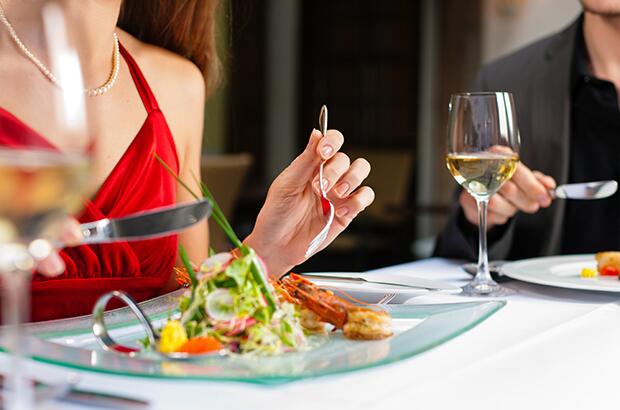
On cruise ships, what gets prepared tableside varies, of course, from line to
line and even vessel to vessel. NCL and several other lines will typically
toss a Caesar salad, prepare a pasta sauce or a dessert flambe tableside. A
few lines considerably raise the bar on sophistication. In addition to the
foregoing, for instance, Crystal filets Dover sole tableside; and also
prepares steak Diane, a cognac-flamed dish that's a staple at New York's
swank 21 Club.
Even for most dishes done tableside, most components still are cooked in the
kitchen first, then assembled tableside. According to Neumeister, the most
complex tableside dish is duck a l'orange, where the duckling is pre-roasted
in the kitchen, then flambeed at the table, finished with a sauce and carved.
In Celebrity's alternative restaurants, approximately one dish out of three
is either assembled, finished or carved in the dining room, Roux says.
Roux recently added an unusual dish to Celebrity's menu: sea bream in a
salted crust for two, where the fish is cooked in the kitchen but
dramatically undraped in the dining room. As Roux describes it, "the beauty
of the fish in salted crust is when you lift up the crust in front of the
passenger; you've got that beautiful steam and the beautiful aroma... the
look of the fish. It just makes people happy!"
For all its flourishes, there are limits to ensure that the show in any
ship's dining room doesn't devolve into a circus. "If you start to cook
[every dish] in the dining room, it's splashing all over, it's smoking, it's
smelling," explains Roux. "I don't want that. I want delicate things
happening. I want finesse at the table. But there is a very thin line
between a show in the dining room and something which is highly skilled and
suddenly turning the dining room into a kitchen."
Thus few dishes ever are completely prepared tableside, according to Roux.
"There are a couple of dishes which come totally raw in the dining room and
which are cooked in the dining room and put together on the plate by the
waiter. But they are simple dishes," he says, such as flambeed shrimp scampi
and veal scaloppini with marsala sauce.
Sometimes hazards hamper tableside service, too, because the devil is in the
details. Without proper staff training, which can takes six months to a
year, even a simple dish could wind up with a faux pas. "A sauce which is
too reduced, for example, into a pan becomes a demi-glaze instead of being a
light jus," says Roux, whose aesthetic concerns extend even to the correct
angle for positioning a puff pastry on the plate.
Indeed, with well-trained staff, even the unthinkable becomes possible and
the most unusual request can be accommodated. Crystal's Neumeister tells of
a couple who requested braised oxtail, a classic French dish that "goes back
to this fine old traditional way of cooking." And they wanted it cooked in
front of them.
"You know, to cook a braised oxtail in red wine takes quite a while,"
Neumeister explains. So preparations for the dinner dish began midday,
braising the oxtail in a wine the couple had personally selected--a Vega
Sicilia, the famed and most expensive Spanish wine, costing nearly $300 a
bottle.
In the evening, the waiter finished the dish tableside, Neumeister
says--searing off the meat, sauteeing the vegetables and onions in the pan
afterwards, de-glazing it with the Vega Sicilia, then reducing the wine,
adding some beef stock and, finally, the oxtail. And--voila--mission
accomplished.
With that level of attention, tableside service seems destined to catch fire
with more than just Baked Alaska.